EN-ICHI Opens Up the Future of Family and Community
[Voices of Japanese Parents Abroad_Korea Vol. 4] The Reality of South Korea’s Declining Birthrate
“Just having children around brightens the whole community,” says Satoko, who is raising five children in Haenam, a town in southwestern South Korea. In a country where the birthrate continues to fall at an alarming pace, having and raising children is deeply welcomed at the community level. In this interview, we asked about the on-the-ground realities of South Korea’s demographic crisis.
“Children Are a Treasure to the Community” — Rapid Decline in Birthrate and the Reality in Rural Areas
— We often hear that South Korea’s declining birthrate is severe. What is the situation like in a rural town such as Haenam?
Yes, the situation is extremely serious. Even among people I know, many families have only one child. There is also a growing tendency for couples to delay having their first child after marriage. At local daycare centers, it is common to see older mothers bringing in very young children.
In rural areas, there remains a strong belief that moving to Seoul equates to success. As a result, young people tend to concentrate in Seoul. However, many of those living there struggle financially and do not return home very often. Consequently, there are many grandparents who rarely get to see their grandchildren. Children have become precious not only to individual families but to the entire community.
We have five children, and I truly feel that the community is delighted about that.
The Fifth Child Made the News — Why the Local Government Came to Celebrate
— We heard that when you gave birth to your fifth child, the community celebrated in a big way. What exactly happened?
After my fifth child was born, I was speaking with staff at the public health center while staying at a joriwon (a postpartum care center). Word spread that a Japanese wife had given birth to her fifth child, and eventually the local government contacted me.
At the time, I had told the health center staff, “There isn’t much support here anyway, and I’m not planning to stay in Haenam long-term, so I’m thinking of registering the birth elsewhere.” Soon after, the head of Haenam County and the local district chief reached out, saying they wanted to come personally to offer congratulations.
In the end, they visited our home and brought gifts such as rice, diapers, wet wipes, and traditional rice cakes. The story was even covered in the local newspaper. The fact that government officials would go to such lengths to celebrate a birth speaks volumes about how serious South Korea’s declining birthrate has become.

Rainbow over Haenam (Photo provided by Satoko)
The Growing Social Issue of “Foreign Wives” in South Korea
— We’ve heard that the issue of “foreign wives” has become a social concern in South Korea. What kinds of situations are occurring?
In South Korea, there has been a significant increase in marriages between Korean men and foreign women. However, there have been cases in which foreign wives received childbirth subsidies and then disappeared. Some have left after acquiring citizenship, and in extreme cases, some have even left their children behind and vanished. There have also been instances of individuals attempting to divorce after receiving childbirth or child-rearing benefits, sometimes filing false claims of abuse. More troubling is that there are lawyers who organize support groups for such cases.
As a result of these issues, childbirth-related payments can no longer be deposited into accounts under the foreign wife’s name; they must be transferred into an account under the Korean husband’s name. Foreign wives are also unable to open bank accounts in their children’s names. From the standpoint of crime prevention, such measures may be understandable. However, for foreign wives like myself who are simply living ordinary married lives, it feels unfair and frustrating.
Mixing the “Best” of Both Worlds in Raising Children Abroad
— What advice would you give to those considering raising children overseas?
“Make sure you always have somewhere to turn.” By that, I mean having someone who will truly listen to you, someone who can offer advice—not just sympathy, but thoughtful, constructive guidance.
Another advantage of raising children abroad is that you can mix the best aspects of parenting from Japan with the best aspects of parenting in your host country. Looking back on my own experience, stepping away from Japan’s strong cultural norm of “You must never inconvenience others” and encountering the Korean mindset of “A quick ‘sorry’ is enough, and then we move on with ‘It’s okay’” significantly changed the way I think about parenting—and about life more broadly.
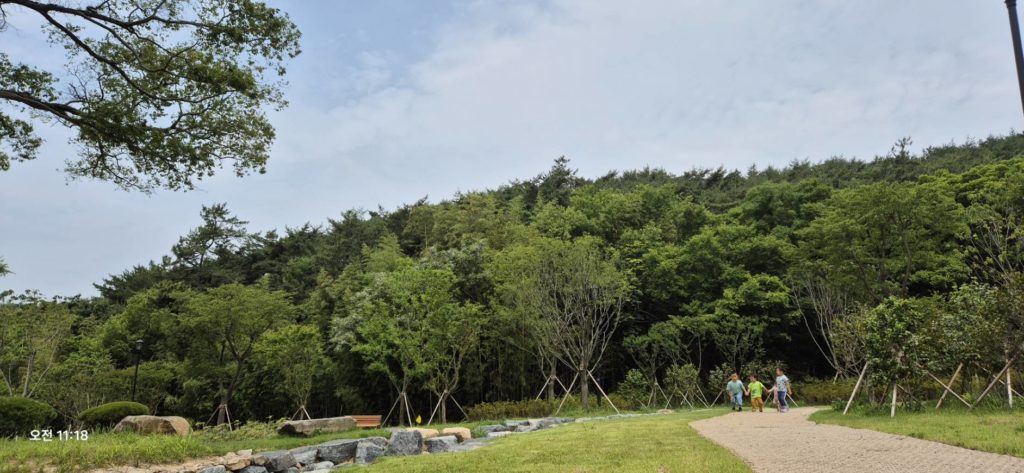
Children playing in the park (Photo provided by Satoko)
[Voices of Japanese Parents Abroad_Korea]
Vol.1 Five Childbirths in Korea
Vol.2 Getting a Good Rest After Childbirth in Korea
Vol.3 Child-Rearing and Education in Rural Korea
Vol.4 The Current State of Korea's Declining Birthrate
Vol.5 Children Cherished in Korea
