EN-ICHI Opens Up the Future of Family and Community
[Voices of Japanese Parents Abroad_Korea Vol. 2] Postpartum Recovery in Korea—A Time to Truly Rest
Satoko lives in the quiet rural town of Haenam, located in the southwestern part of South Korea, where she is raising five children. In Korea, there are dedicated facilities designed to ensure that mothers can properly rest after childbirth. We spoke with Satoko about postpartum life in Korea.
“Postpartum Is a Time to Rest” — The Choriwon, a Product of Korean Culture
— Could you tell us about the postpartum care facilities unique to Korea, known as Choriwon (postpartum care centers)?
In Korea, there is a strong cultural belief that women must rest thoroughly after giving birth, and this is how Choriwon became widespread. I’ve heard that this custom originated from the experiences of the grandmother generation, many of whom harmed their health by returning to farm work or other labor immediately after childbirth.
A Choriwon is a facility where both mother and baby stay together, and everything except personal care is taken care of for you. You only need to bring items like cosmetics, toiletries, and underwear. All meals are provided, and laundry is done for you as well. The food is luxurious and delicious—three full meals a day plus three snacks, such as pumpkin porridge, black sesame porridge, and red bean porridge. There are also programs like childcare classes, yoga, and optional paid massage services.
— How much does it cost to stay at a Choriwon?
Typically, a two-week stay costs several hundred thousand yen—around 600,000 yen in many places. However, in Haenam, where I live, there is a Choriwon built by South Jeolla Province. Residents of the province are eligible for discounts, and anyone who wishes to use it can do so. The cost is about 400,000 yen, which is relatively affordable. For foreign residents, additional subsidies apply. From my first child onward, my out-of-pocket expense was only about 40,000 yen. The rest of the cost was fully covered by South Jeolla Province.
The length of the hospital stay after childbirth varies by hospital, but for a natural birth, mothers are usually discharged after three to five days and then move to a Choriwon. You can choose to stay for one or two weeks, and up to three weeks is possible, but because the facilities are very popular, few people are able to stay for the full three weeks. I stayed for two weeks.
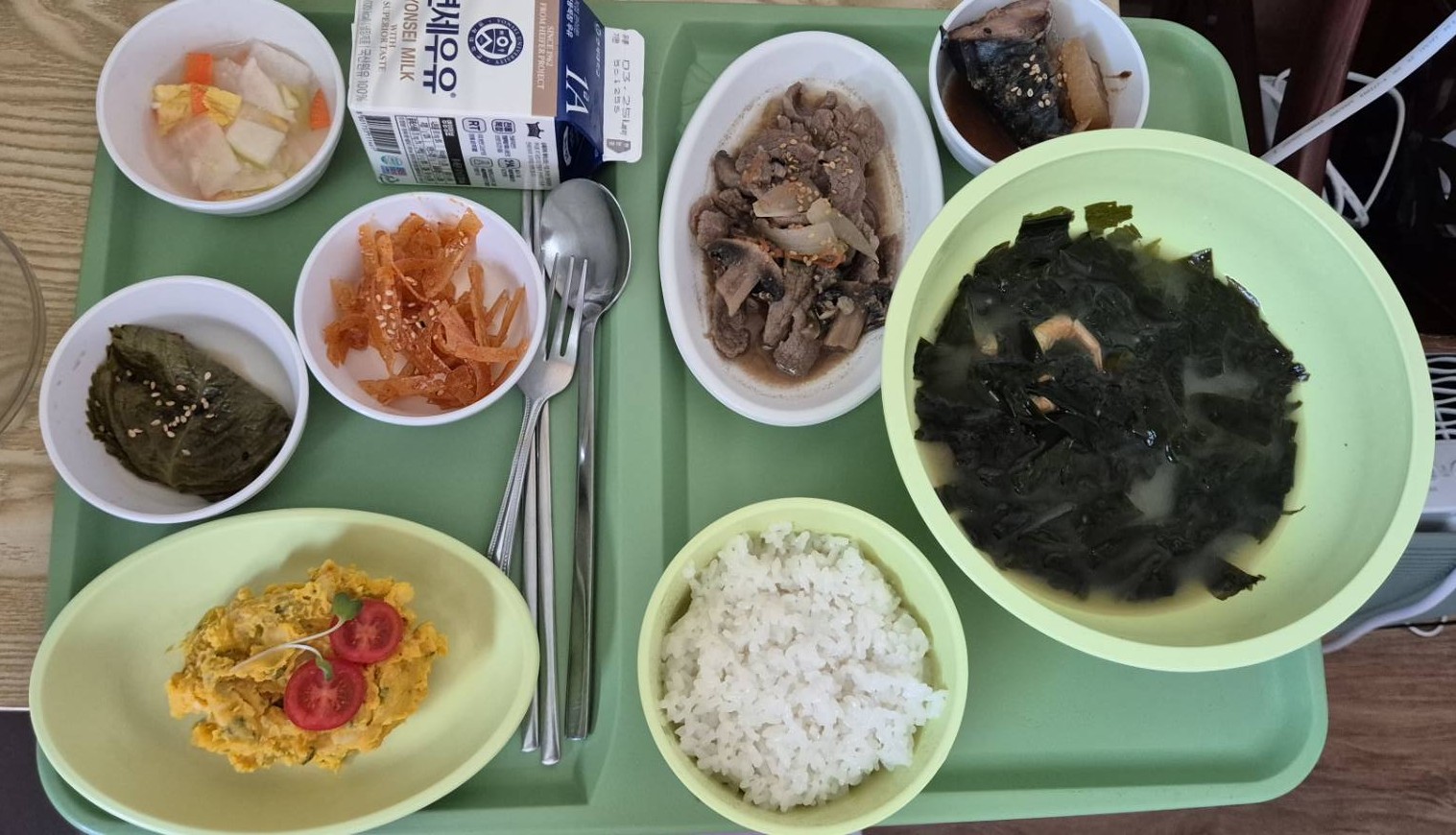
Meals at a Choriwon (provided by Satoko)
Postpartum Care Supported by the State and Local Governments — Visiting Helpers “Doumi”
— Could you also tell us about the public postpartum support system known as Doumi (visiting helpers)?
In Korea, you can request a visiting helper called a Doumi after childbirth. They are similar to professional babysitters and are well-trained and experienced in caring for newborns.
While fees vary depending on household income, Doumi services provided through Multicultural Family Support Centers for international families are completely free. These centers are operated by the national government.
A Doumi typically comes from 9:00 a.m. to 5:00 p.m. and helps with baby care, cleaning, laundry, and general household chores, allowing the mother to rest. I was able to use this service for about one month—around 19 weekdays, excluding weekends. By combining the Choriwon stay with Doumi support, it’s possible to rest your body for nearly the first 100 days after childbirth.
— Are there also financial supports related to childbirth and childcare?
Yes, there are childbirth support payments provided separately by South Jeolla Province, the Korean national government, and Haenam County.
However, foreign wives cannot receive childbirth lump-sum payments or related benefits under their own names. This is because there have been cases where some foreign wives received the money and then fled—either taking the child with them or leaving the child behind. In fact, there are reportedly communities that exist specifically to facilitate such escapes, which is a very serious issue. As a result, in my case, all payments are deposited into my husband’s bank account under his name.
Community Support and Changes in My Husband
— Were you able to rely on family or relatives for childcare support? How did you seek help within the community?
My husband is one of seven siblings, but my sister-in-law who lives nearby has health issues, and the other relatives live far away or are busy with work, so it was difficult to rely on them.
However, during my stay at the Choriwon and other difficult times, acquaintances helped by looking after my older children, which was a great relief. Also, the fact that my husband serves as the neighborhood association head worked in our favor when it came to receiving community support. In Korea, neighborhood leaders tend to be trusted and respected, so in emergencies—such as when we needed someone to watch the children at short notice—it was often possible to ask for help and have things work out. This support was incredibly helpful.
— How do you and your husband divide childcare and household responsibilities?
My husband is very work-focused and the type who doesn’t really “see” housework—he doesn’t seem to notice even when laundry or dishes pile up (laughs). In the past, he wasn’t very proactive about housework or childcare. However, when we had our fifth child through a home birth, I truly couldn’t move at all, and for the first time, my husband took on all the household chores and childcare. I feel that the birth of our fifth child was a turning point for him. Even now, while working very hard, he helps with things like taking the children to school.
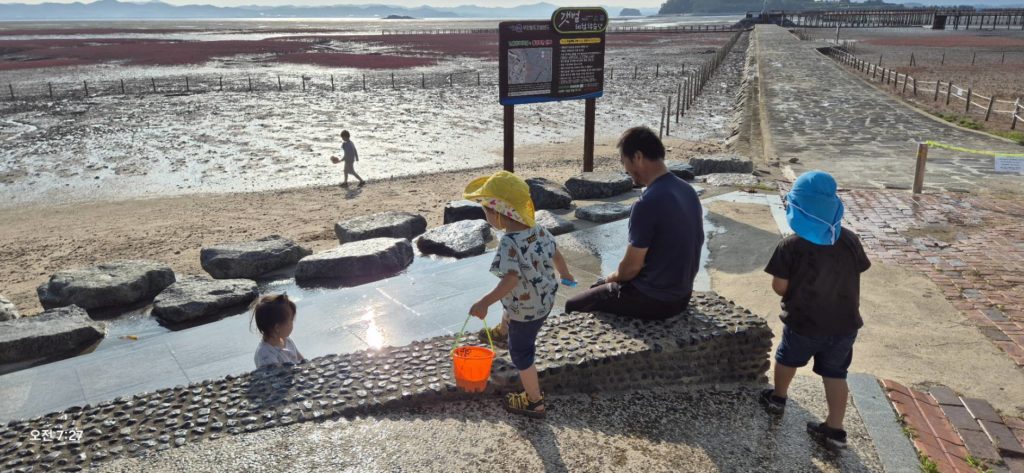
Children playing on the beach (Photo provided by Satoko)
[Voices of Japanese Parents Abroad_Korea]
Vol.1 Five Childbirths in Korea
Vol.2 Getting a Good Rest After Childbirth in Korea
Vol.3 Child-Rearing and Education in Rural Korea
Vol.4 The Reality of South Korea’s Declining Birthrate
