EN-ICHI Opens Up the Future of Family and Community
[Voices of Japanese Parents Abroad_Cambodia vol.4] An Overly Flexible Education System and the Lack of Emotional Education(Automatic Translation)

Sayaka, who lives in Phnom Penh with her Cambodian husband and their five children, spoke with us this time about education in Cambodia. Her older children are in elementary school.
“Extremely Flexible” Cambodian Education
— This time, we’d like to ask about Cambodia’s education system. At what age do children start school?
Children enter primary school at age six—one year earlier than in Japan. Before that, there isn’t a clear distinction between daycare and kindergarten; many facilities accept children from around two or three years old. At the daycare I run, there was strong demand from parents who wanted to enroll one-year-olds, so we created a class for them.
— Is it common for children to attend public elementary schools?
There are both public and private elementary schools. Public schools, of course, use Cambodian textbooks and teach in Khmer. Tuition is free, and meal fees cost around 10 to 20 USD per month. However, the quality of public education varies widely, so families with some financial means tend to choose private schools seeking higher-quality education.
Broadly speaking, private schools fall into two categories. One type is the international school, where classes are taught mainly in English using English-language textbooks. The other type is the local-style private school, which follows the Cambodian curriculum in Khmer but offers richer programs in subjects like music, physical education, and languages. There are Korean, Thai, Chinese, and Malaysian schools, among others, each with its own distinctive character. Tuition ranges from about 100 USD up to over 1,000 USD per month.
— What kind of school do your children attend?
My older kids go to a Korean-affiliated local school. Classes are conducted in Khmer using Cambodian textbooks, but they also study English and Korean. Most teachers are Cambodian; English teachers are Filipino, and Korean teachers are Korean. Tuition is about 150 USD per child per month—currently half price thanks to a promotional discount, though I’m not sure when it will go up. My younger children attend the daycare I operate.
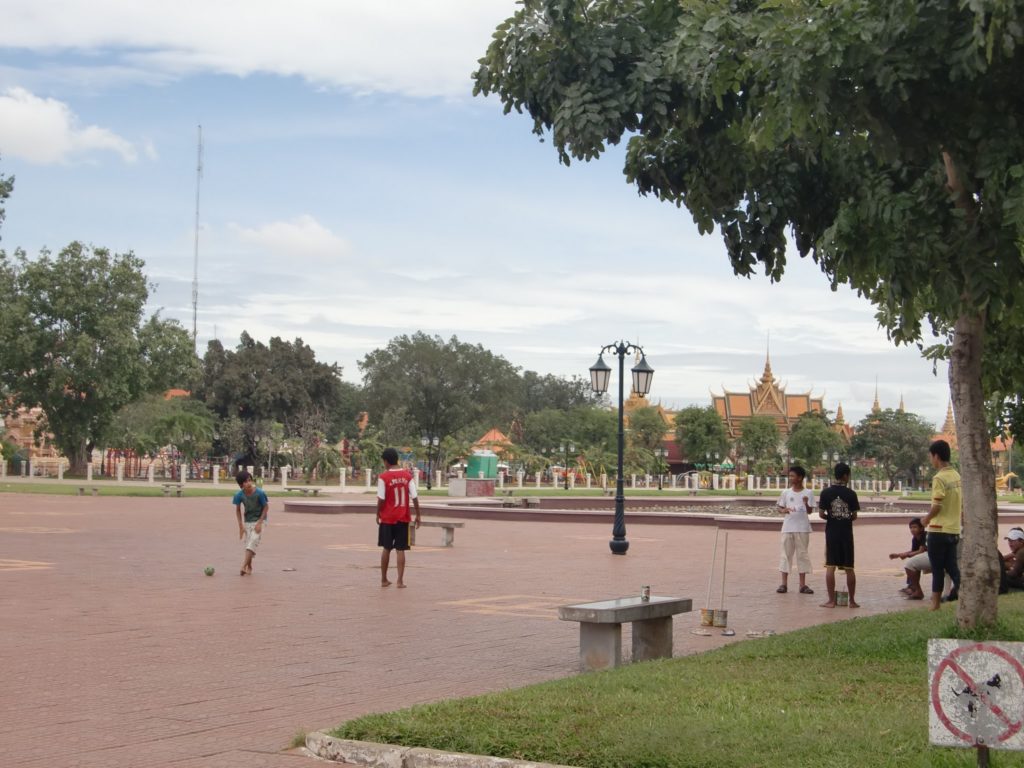
Children playing in a square in Phnom Penh
Children Who “Hop from School to School”
— With so many private options, school selection must be challenging.
Yes, it is. Tuition is often paid in one-, three-, or six-month installments, so quite a few children transfer at those intervals. Some families try one school for three months and, if it doesn’t feel right, move to another. It’s common for kids to move around between schools.
— That’s quite different from Japan.
Exactly. There isn’t the same sense that “once you start, you stay until the end.” Instead, people think, “If the school doesn’t fit, just change it,” or “What matters is finding a place where the child enjoys learning.” In that sense, education here feels less like compulsory schooling and more like a paid service—something families choose and can change. That gives a certain sense of freedom of choice.
*The photo above is for illustrative purposes only.
A Society with “Zero Emotional Education”
— What differences have you noticed between education in Cambodia and Japan?
The biggest one is the absence of emotional education. There’s almost no focus on nurturing children’s inner lives or emotions. For instance, if a child cries or expresses anxiety, teachers rarely show empathy or try to comfort them.
This attitude is common at home as well, so I often meet adults whose emotional development seems stunted. Yet, oddly enough, people here still maintain warm, close relationships—they have a natural sense of human closeness.
In recent years, some programs related to emotional learning have begun to appear, so I’m curious to see how Cambodian children will grow as those efforts spread.
— Is there anything you personally keep in mind when interacting with your children?
Because schools don’t provide emotional care, I try to do that at home. I ask questions like, “Why do you think your friend acted that way?” or “How do you think the teacher felt at that moment?” I try to build empathy through dialogue. I see the family as both the last line of defense and the most important place for emotional education before children go out into society. I also make a point of having daily parent-child conversations and of not being a perfect parent—leaving room for vulnerability and growth.
— Since you run a daycare, do you apply these ideas there as well?
Yes. Many Cambodian daycare teachers are rather matter-of-fact, so I constantly remind them of the importance of feelings and emotional warmth. It doesn’t always get through right away, but I believe “continuity is power,” so I keep approaching them with the same attitude.
Sometimes my trust gets tested, but I see that as mutual—it’s part of building honest, open relationships. My goal is to foster a transparent, genuine rapport with the Cambodian teachers, based on mutual respect and support.
“Making Do with What You Have”
— Are there other value differences you’ve noticed while living in Cambodia?
Definitely. Cambodians tend to make do with what’s available, while Japanese people strive to improve and refine things. In a way, each outlook complements the other. I think it’s important to see both value systems positively and learn from each other’s strengths.
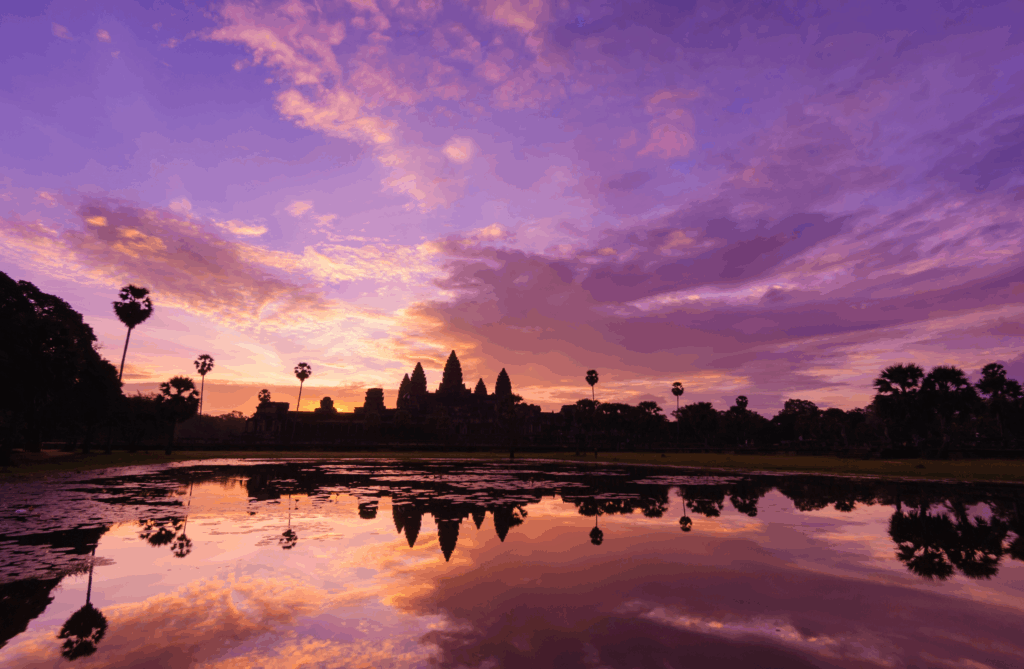
Angkor Wat
[Voices of Japanese Parents Abroa_Cambodia]
Vol. 1 Raising Five Children in Phnom Penh
Vol. 2 A Birth Environment Where You Can Only “Pray”
Vol. 3 The Reality of Balancing Household Duties, Childcare, and Work
Vol. 4 An Overly Flexible Education System and the Lack of Emotional Education
