EN-ICHI Opens Up the Future of Family and Community
[Voices of Japanese Parents Abrad_Cambodia Vol. 3] The Reality of Balancing Household Duties, Childcare, and Work

Sayaka, who is raising five children in Phnom Penh with her Cambodian husband, also runs a nursery school in the city. In this interview, she talks about the realities of juggling work and childcare as a working mother in Cambodia.
Maternity Leave: Just Three Months Before Returning to Work?
—Is it true that many women return to work almost immediately after giving birth?
Yes, maternity leave in Cambodia is extremely short. It’s usually just three months, and even if extended, at most about six months including pre- and post-natal leave. So, going back to work after three months is taken as “normal.” Especially among the current generation of parents, dual-income households have become the norm. A few years ago, children were more commonly cared for by grandparents, but these days, more families are choosing to raise their children on their own.
—Do most parents put their babies in daycare at three months old?
Not really. Most daycare centers don’t accept babies that young. They usually start at around ten months. Until then, parents have no choice but to care for the baby at home.
Typically, grandparents or relatives step in, but when that isn’t possible, families often rely on housekeepers.

Cambodian market situation ①
Housekeepers as the Main Support for Childcare?
—Is hiring a housekeeper common practice?
Yes, it’s quite common. Some live with the family full-time, while others only come during the day.
The cost varies. A live-in housekeeper who cooks and cleans as well can cost around $400–500 per month (roughly ¥70,000–80,000). Since the average salary in Cambodia is $250–400, it’s considered a decent wage. But of course, only households with sufficient financial means can afford a full-time live-in helper.
—Do you have a housekeeper at home?
No, we don’t. My husband and I split the work ourselves. But many families around us do rely on housekeepers. In fact, in a society where both parents are expected to work, hiring help is considered normal. Some households entrust almost everything—from housework to childcare—to their live-in helpers.
—Why did you choose not to hire one?
Of course, I’d like the help if we had the resources, but finding someone trustworthy takes time and effort, and relationships don’t always last. In the end, we decided it would be better to manage everything ourselves. There’s also the stress of having someone else living in your home. Most importantly, we strongly feel, “We want to raise our children ourselves.”

*The photo above is for illustrative purposes only.
Getting Through Each Day with Teamwork
—You’re raising five children without outside help? That sounds intense!
It is (laughs). Cooking, laundry, school drop-offs and pick-ups—it’s a lot. But my husband’s support makes a huge difference. If I’m cooking, he’s with the kids. If I’m giving the children a bath, he’s making dinner. We’ve learned to naturally coordinate and share responsibilities. At first, we argued often, but over time we’ve developed a kind of unspoken rhythm.
—Was he always this cooperative?
Not at first. With our first three children, I handled most of the childcare myself. But when our fourth and fifth were born, something shifted. We began finding a better balance, learning to complement each other instead of clashing. I think my husband has really grown as a father with every child we’ve had.

*The photo above is for illustrative purposes only.
The Role of Fathers in Cambodia: Still Limited?
—Do Cambodian fathers usually share household and childcare responsibilities?
It depends. In my immediate circle, many couples have supportive husbands who help with housework and childcare. But if you look more broadly, the reality isn’t as encouraging. Many men spend their time drinking, avoiding both household chores and work.
—That sounds difficult.
Yes. But you have to understand the cultural background. Cambodia has a tradition of “matrilocal residence”—husbands often move in with the wife’s family. Perhaps because of that, women often play the stronger role, both financially and emotionally, in the household.
The Biggest Daily Challenge: Meals
—Balancing work and housework must be tough. What’s the hardest part?
Cooking, definitely. No matter how busy you are, your children still need proper meals. Preparing them every day can feel overwhelming. If there’s one thing I wish I could outsource, it’s cooking.
—Do you have any tricks for making it easier?
Not really, but I always keep quick-cooking dried noodles at home (laughs). We don’t have a microwave, so everything has to be freshly prepared. I prefer serving freshly cooked food anyway, so I rarely make dishes in advance. I just cook enough for each meal—rice, stir-fries, grilled dishes, whatever works. Having noodles on hand helps when I need something fast. But balancing nutrition is always a challenge.
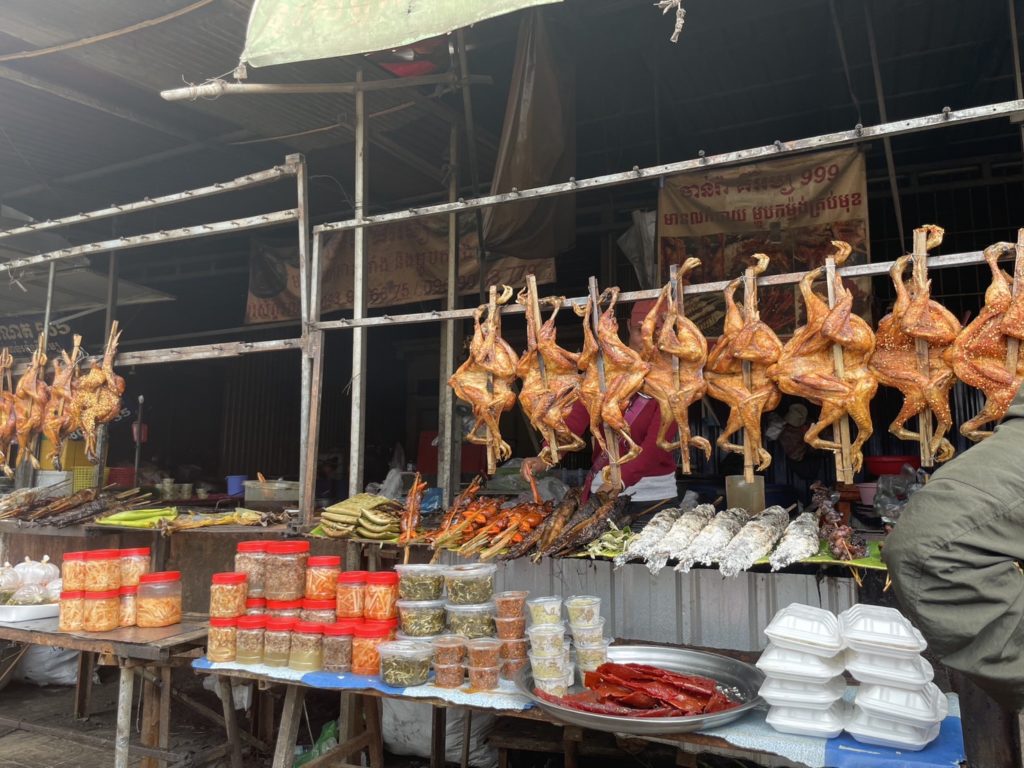
Cambodian market situation ②
[Voices of Japanese Parents Abroa_Cambodia]
Vol. 1 Raising Five Children in Phnom Penh
Vol. 2 A Birth Environment Where You Can Only “Pray”
Vol. 3 The Reality of Balancing Household Duties, Childcare, and Work
Vol. 4 An Overly Flexible Education System and the Lack of Emotional Education
