EN-ICHI Opens Up the Future of Family and Community
Series: Human Life Cycle and Family 3: Human Bipedalism

This series takes the distinctive characteristics of the human life cycle as its central theme, with the aim of deepening our understanding of family relationships and child-rearing. Accordingly, in order to incorporate biological attributes alongside psychological discussion, the author develops the argument primarily with reference to “Evolution of the Brain” by the renowned neurophysiologist John C. Eccles.
- The Emergence of Characteristics That Distinguish Humans
- Bipedalism Preceding Brain Expansion
- Bipedalism Enabled Long-Distance Travel
- Australopithecus Walking as a “Family”
The Emergence of Characteristics That Distinguish Humans
In the previous installment, we examined Eccles’s discussion in Chapter 5 of “Evolution of the Brain” regarding human brain size and childbirth. We noted that human infants may be regarded as being in a quasi-fetal state for several months to approximately one year after birth; nevertheless, childbirth cannot be delayed any further, given the size of the brain that must pass through the birth canal at birth. Although human childbirth is often described as difficult, it reflects evolutionary adaptations that make birth possible for both mother and child. However, Eccles also states that it remains “completely unknown” what specific genetic changes during evolution made this extended fetal-like period possible.
As discussed so far, the distinctive characteristics that set modern humans apart from other animals are known to have emerged gradually over a long evolutionary period. To organize this discussion, let us refer to the classification by Klein, cited by Yamagiwa (2007). According to this framework, major transformations in human evolutionary history include: (1) the emergence of upright bipedalism (5.0–2.5 million years ago), (2) a slight increase in brain size (2.5–1.6 million years ago), (3) the completion of body proportions (1.6–0.8 million years ago), (4) the completion of brain size (0.8–0.05 million years ago), and (5) the explosion of culture and the use of language (after 50,000 years ago).
While these changes are considered essential for the emergence of modern humans, “it is not well understood how the traits that appeared at each stage contributed to the next stage” (Yamagiwa). As a result, evolutionary history shows long periods in which newly emerged major traits persisted without further dramatic change. In this sense, human evolution is better understood not as a linear process, but as one that proceeds in a stair-like, stepwise manner. Current molecular clock estimates suggest that humans diverged from a common ancestor with chimpanzees approximately six to seven million years ago. Meanwhile, fossil evidence of bipedal human ancestors has been dated to roughly the same period, reinforcing the view that bipedalism was one of the earliest major evolutionary changes in human history.
Bipedalism Preceding Brain Expansion
In this installment, we turn to Chapter 3 of Eccles’s Evolution of the Brain, titled “Human Brain Evolution: Bipedalism and Agility.” Eccles provides a detailed account of the neurophysiological mechanisms required for the evolution of bipedalism, and readers with particular interest are encouraged to consult the original text. From the perspective of brain evolution, Eccles argues that “most of the evolutionary changes from simple mammals had already occurred in the higher primates, our distant hominoid ancestors.” Nevertheless, he emphasizes that subsequent developments—“bipedalism, refined hand movements for tool- and weapon-making as well as social life, and ultimately linguistic expression involving the pharynx, tongue, larynx, and respiratory muscles”—were of critical importance. The transition from quadrupedalism to bipedalism required major anatomical changes and must also have involved a fundamental “redesign of the nervous system.”
[Figure 1] Comparison of Ape and Human Skeletons
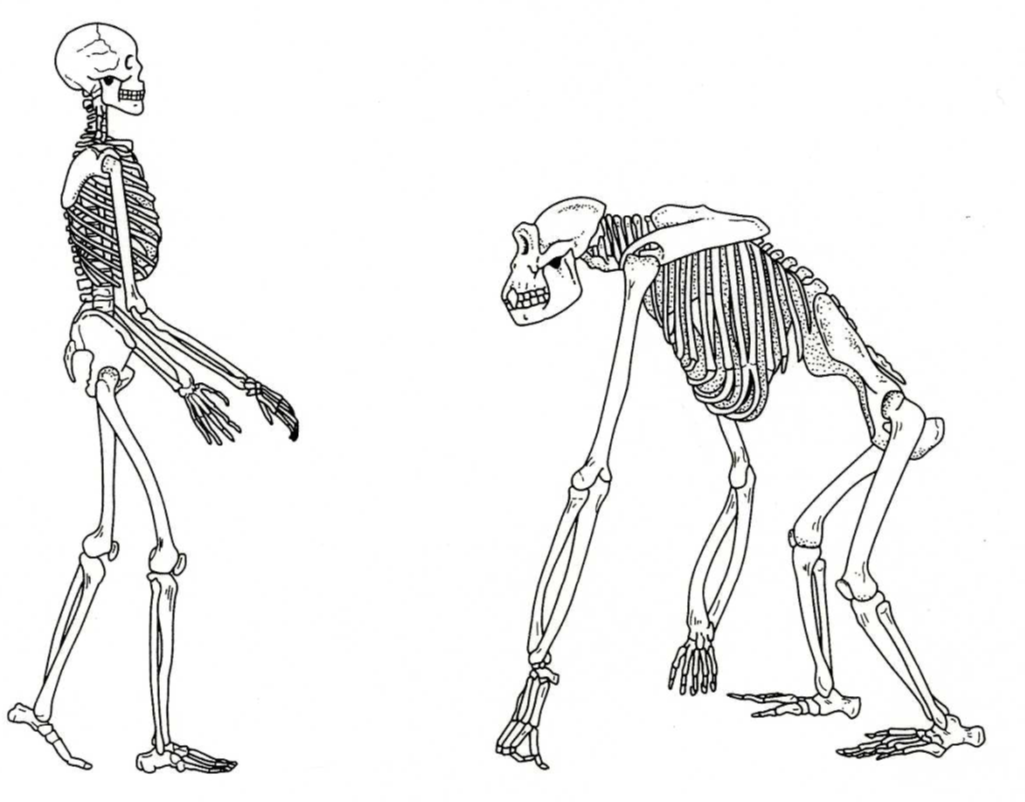
Source: Yamagiwa, J. (2008), Human Evolution: Developments from Primatology, p. 68. Figure 3.3.
According to the paleontologist Stephen Jay Gould, when Australopithecus was discovered in the 1920s, many scientists opposed placing it within the human lineage (Gould, 1977). At the time, many scholars believed that brain expansion played the central role in human evolution. Consequently, they imagined the fossil “missing link” as an intermediate being with a hunched posture and a brain size halfway between apes and humans. However, the brains of Australopithecus species were only slightly larger than those of apes relative to body size, while they were already regarded as upright bipeds. Gould criticized this failed prediction, arguing that it likely reflected Western cultural bias that overemphasizes the value of human brain and mind. From a materialist standpoint, he praised Freud and Engels for emphasizing the emergence of upright bipedalism in human evolution. Gould returned to this issue in later essays, stating emphatically that “upright posture itself was the truly astonishing and difficult event—a sudden and fundamental reorganization of bodily structure” (Gould, 1980). While I do not share Gould’s materialist position, I agree with his concern that cultural bias must be carefully considered in discussions of human evolution.
Bipedalism Enabled Long-Distance Travel
Returning to Eccles’s discussion of bipedalism, he first explains skeletal changes in Australopithecus associated with upright walking. He notes that fossil evidence shows that in Australopithecus africanus, “the structure of the spine, pelvis, and hind limbs had already evolved to suit an upright posture, although the articulation between the head and spine had not yet fully evolved.” Eccles further argues that the human style of long-stride bipedal walking is unique and represents the most efficient mode of terrestrial locomotion. Based on fossilized footprints of A. africanus, he concludes that these hominins already exhibited highly developed bipedal walking. Although various hypotheses have been proposed regarding why humans acquired bipedalism, no single theory has been firmly established. One influential view, endorsed by Eccles, is that bipedalism provided an efficient, energy-saving means of locomotion. Yamagiwa elaborates on this point, noting that modern African apes typically walk only a few hundred meters to two kilometers per day, rarely exceeding ten kilometers. In contrast, contemporary hunter-gatherers often walk as much as thirty kilometers a day, frequently while carrying hunted animals or gathered plants. Humans, he argues, are thus exceptionally well adapted for long-distance walking (Yamagiwa, 2007).
Australopithecus Walking as a “Family”
One of the most striking fossil records related to Australopithecus bipedalism is the set of footprints discovered at Laetoli in northern Tanzania. Eccles describes them as “the most remarkable fossil evidence.” The footprints were impressed into volcanic ash that later hardened into tuff and were preserved by a subsequent volcanic eruption. They clearly show skilled bipedal walking by left and right feet with human-like toes. From the spacing of the footprints, two individuals approximately 141–150 cm in height are inferred. Notably, one individual followed closely behind the other, stepping precisely into the footprints of the one ahead. Moreover, a third, smaller individual appears to have walked slightly to the left of the larger figure, suggesting that they may have been holding hands.
[Figure 2] Fossilized Footprints from Laetoli
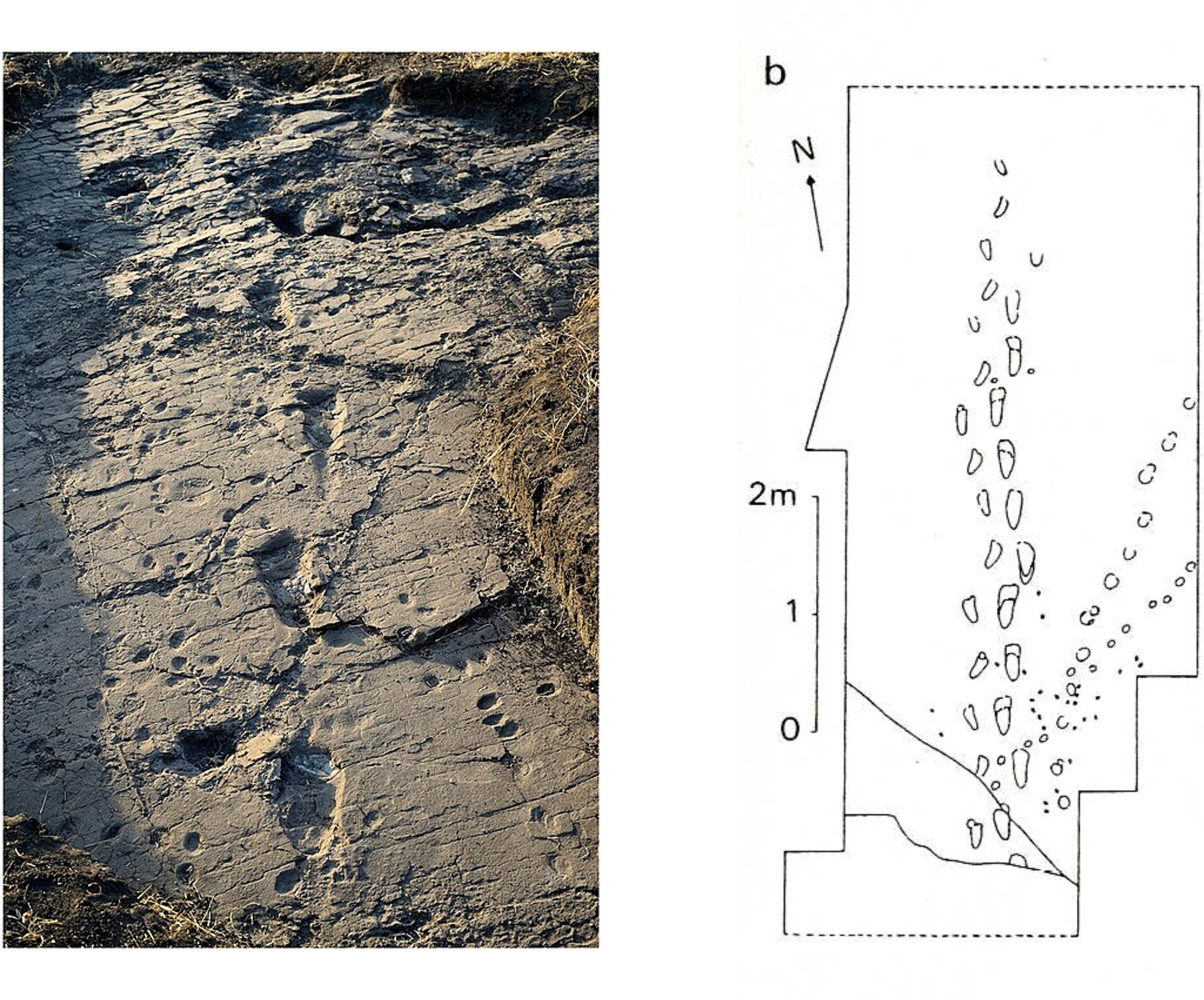
Sources:
Left: “Test-pit L8 at Laetoli Site S” by Fidelis T. Masao et al., CC BY 4.0, Wikimedia Commons. (https://commons.wikimedia.org/wiki/File:Test-pit_L8_at_Laetoli_Site_S.jpg)
Right: Eccles, J. C., trans. Ito, M. (1990), Evolution of the Brain, p. 51, Fig. 3-11.
Eccles explains that these footprints not only demonstrate the well-practiced bipedalism of Australopithecus but also reveal evidence of “human relationships.” He revisits this footprint evidence in Chapter 5 when discussing the human family, stating that although footprints are the only direct record of Australopithecus behavior, an imaginative interpretation suggests that nuclear families may have existed as early as 3.6 million years ago: a couple walking carefully in step, with a child holding hands with one of them.
References
- Eccles, J. C. (1989). “Evolution of the Brain: Creation of the Self”. Routledge. Japanese translation: Eccles, J. C., trans. by Ito, M. (1990). Nō no Shinka. University of Tokyo Press.
- Gould, S. J. (1977). Ever Since Darwin: Reflections in Natural History. W. W. Norton. Japanese translation: Gould, S. J., trans. by Uramoto, M. & Terada, H. (1995). Darwin Irai. Hayakawa Publishing.
- Gould, S. J. (1980). The Panda’s Thumb: More Reflections in Natural History. W. W. Norton. Japanese translation: Gould, S. J., trans. by Sakuramachi, S. (1996). Panda no Oyayubi. Hayakawa Publishing.
- Yamagiwa, J. (Ed.). (2007). Shirīzu Hito no Kagaku 1: Hito wa dono yō ni shite tsukurareta ka [Series: The Science of Humans 1: How Were Humans Formed?]. Iwanami Shoten.
- Yamagiwa, J. (2008). Jinrui Shinkaron: Reichourui-ron kara no Tenkai [Human Evolutionary Theory: A Primatological Perspective]. Shōkabō.
