EN-ICHI Opens Up the Future of Family and Community
【A Science-Minded Mom’s Observation Report】 How My Children Came to Understand “Gender” (Automatic Translation)
*“EN-ICHI Partners” are contributing authors who provide articles to EN-ICHI from their respective fields of expertise.
As a mother of three and a science researcher, I find children's growth to be like a grand research theme integrated into everyday life. Physical development, cognitive formation, psychological processes—the way these advanced functions develop naturally through daily life and interactions, without being taught by anyone, is always moving to witness. What was particularly impressive was the process by which
my children came to recognize "gender ." Recently, there has been a boom in sex education, and "sex education at home" has suddenly become commonplace, and I myself have become more conscious of wanting to "actively convey what needs to be said about sex to my children as a parent." On the other hand, I have also had more opportunities to hear the idea that "gender is not just male and female" and "masculinity and femininity are unconscious biases," and I have sometimes found myself wondering "how should I explain the terms male and female to my children?" With
such questions in the back of my mind, I have objectively observed the growth of my three children with the eyes of a science-minded mother, and I have come to feel that there are some commonalities in the process of recognizing "gender." While this is just one family's case, I'd like to compile an observation report of my children in the hope that it might serve as a useful resource for thinking about better "sex education."
The Moment They Noticed “Gender”
My eldest son first showed a clear awareness of “gender” when his younger sister was born. He was just under three years old at the time. Having just begun to hold simple conversations, he was fascinated by the newborn and eagerly helped with her care.
One day, after repeatedly helping with diaper changes, he suddenly asked:
“Did I not have a penis when I was a baby?”
I still remember struggling not to laugh at the unexpectedness of the question.
Most likely, he had combined the following observations:
ーHis sister did not have something that he did
ーHis sister was “small”
ーHe himself was “big”
From these, he formed his own hypothesis: People are born without a penis, and it appears as they grow. Even at the age of three, he was observing differences between himself and others and attempting to derive a general rule inductively. As a researcher, I was struck by the sophistication of this reasoning process.
Later, when he saw my body in the bath, he commented:
“Oh, Mom doesn’t have one either.”
In that moment, his hypothesis collapsed.
So I asked,
“Well, what about Dad?”
He immediately responded:
“Dad has one! Oh, I see—boys have them!”
He quickly constructed a new hypothesis that accounted for all observable facts.
He looked completely satisfied. I believe this experience marked the first time he connected the words “boy” and “girl” with physical characteristics.
The “Need to Confirm” Phase
After that, between the ages of four and five, he often said things like:
“I’m a boy, Dad is a man, Mom is a woman, and my sister is a girl.”
“Is XX (his friend) a boy?”
“Is XX teacher a woman?”
He repeatedly checked the gender of people around him, as if verifying the criteria for classification—almost like an AI learning from data.
Then, around age six,
while we were choosing a birthday present on a smartphone, he casually said:
“This looks like a girl’s toy, so it might be good for my sister’s birthday.”
Until then, I had rarely used expressions like “for boys” or “for girls,” so this came as a surprise.

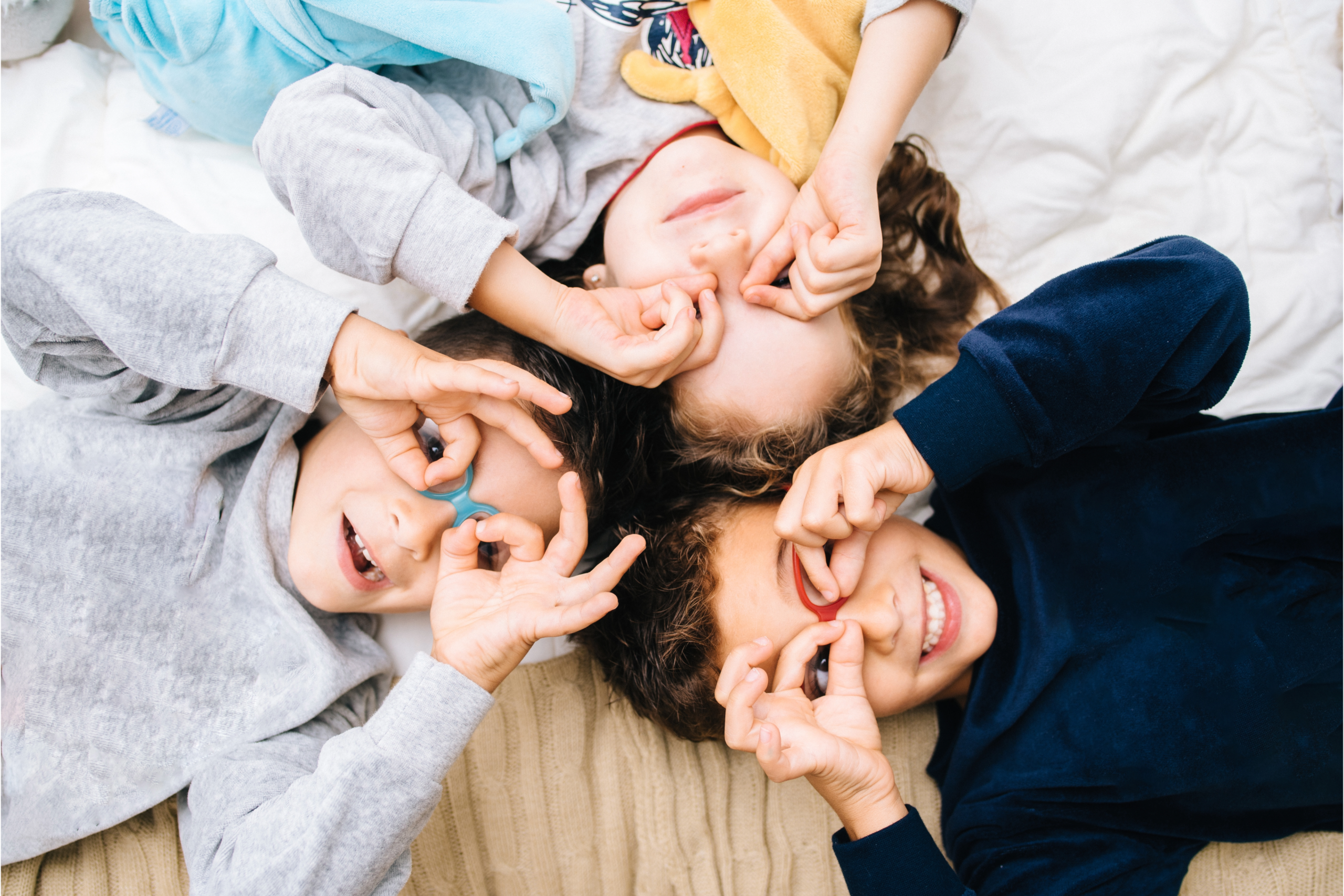
*Photo for illustrative purposes only
My Daughter: An Urge to Classify
My daughter also went through a phase, around age five, when she was deeply interested in categorizing people as “boys” or “girls.”
Unlike her older brother, she tended to verbalize her thoughts more freely. While riding behind me on the bicycle on the way to daycare, she would say things like:
“Mom and I have long hair, so we’re girls.”
“Big brother and Dad have short hair, so they’re boys.”
“But XX teacher is a girl and has short hair. And my little sister has short hair too!”
She would continue analyzing on her own, almost endlessly.
At times, she would say things like: “We’re girls, so we like pink!”
Listening to her “in the middle of data processing,” I found myself simply observing.
Even When We Tried to Be Careful
Personally, I had always wanted to avoid imposing rigid stereotypes on my children. Influenced by the idea that expressions like “masculine” and “feminine” reflect adult biases, I had tried not to use such language.
This approach was also evident at their daycare.
It was rare to hear comments like:
“You’re such a girly, cute girl.”
Instead, when children said things like:
“It has frills!”
“I like pink!”
Teachers would respond neutrally:
“You like frills, don’t you?”
“You like pink, don’t you?”
They acknowledged the child’s perspective without linking it to gender.
And yet, despite these efforts, children naturally tried to understand what “boys” and “girls” meant. Watching this, I gradually came to feel:
"Perhaps children themselves have a desire to understand the concept of 'gender' as part of the process of understanding themselves and others."
An Innate Drive to Learn
This perspective was inspired by the Montessori concept of the “absorbent mind” and “self-directed learning.”
Developed by Maria Montessori, this educational philosophy is based on careful observation and emphasizes that children possess an innate drive toward independence and development.
For example:
・Repeatedly asking, “What’s this?”
・Wanting to touch food directly
・Climbing and jumping whenever there’s a step
・Noticing even small changes in routine
・Easily memorizing meaningless strings of letters or numbers
These behaviors are familiar to anyone who has raised children. In Montessori education, they are understood as expressions of a child’s internal drive to develop specific abilities.
Furthermore, because these behaviors tend to appear consistently during specific periods of development, they are understood as part of what is known as “sensitive periods.” During these times, children are naturally driven to develop particular abilities on their own—such as language, sensory perception, movement, order, an interest in small objects, numbers, writing, reading, and cultural norms and manners. Montessori education emphasizes that, during these sensitive periods, adults should avoid unnecessarily restricting such behaviors. Instead, the goal is to create a safe environment in which children can fully explore and develop these emerging abilities.
I have witnessed this time and again with my own three children. When they are in a phase of “I absolutely have to do this right now,” I have found that, rather than redirecting them for the sake of convenience, allowing them—whenever possible—to continue until they feel satisfied often leads them to move on surprisingly smoothly. Experiences like these have made me strongly aware that something like a “sensitive period” in development truly does exist.

*Photo for illustrative purposes only
A Desire to Grasp “Gender”
When I reflected on how both my eldest son and daughter showed a strong interest in “gender” between the ages of two and six, it struck me as highly similar to other developmental patterns I had observed. Their persistent efforts to understand the differences between “boys” and “girls” seemed to reflect an intrinsic drive to grasp the essence of the attribute they were born with—their own gender—and, through that, to deepen their understanding of themselves. I came to feel that this was an expression of their self-directed learning, and perhaps it would not be an exaggeration to describe this as a kind of “sensitive period for gender.”
Strictly speaking, Montessori education does not define a “sensitive period for gender.” However, within the broader “sensitive period for the senses,” two stages are identified: an initial phase (ages 0–3), in which children absorb impressions of the world through their five senses, and a subsequent phase (ages 3–6), in which they begin to organize, compare, and classify those impressions. From this perspective, my children’s behavior between the ages of two and six felt entirely consistent with this framework. They were actively absorbing observable traits—such as physical differences and individual characteristics—and then using those impressions to compare, categorize, and assign meaning to what they perceived as “gender.”
When you think about it,
“penis,” “poop,” and “farts”—
from around the age of two, children become surprisingly fascinated by these topics.
No one explicitly teaches them, and yet they are irresistibly drawn to them. This pattern also overlaps with the timing and direction of interest described in Freud’s developmental stages, such as the anal stage (around ages 1–3) and the phallic stage (around ages 3–5).
A “Sensitive Period for Gender” as a Developmental Stage
Could it be that there is a developmental stage—a “sensitive period for gender”—around the ages of two to six?”
What do you think of this perspective, as parents raising children?
When I talk with friends and other parents, I often find that many can relate to seeing similar behaviors during this stage. This makes me feel that such experiences may not be uncommon. At the same time, however, in academic fields such as developmental psychology, I have rarely come across detailed descriptions of how children come to recognize their own gender.
One possible explanation is that these behaviors tend to appear most clearly in the context of everyday family life—situations where children can naturally observe physical differences and freely express their thoughts. For that reason, they may have been less likely to be captured and examined as formal subjects of research.
Invitation to Participate in a Reader Survey
With that in mind, I have decided to invite readers of this column to take part in a short survey.
[EN-ICHI Reader Survey: We Welcome Your Childcare Observation Reports!]
If you have any memorable episodes involving a child close to you—such as a moment when they became interested in gender, or something they said about it—I would be very grateful if you could share them through the form above. You are also welcome to share memories from your own childhood, if there is anything you happen to remember.
Based on the responses we receive, I hope to write a new article for EN-ICHI. Like Maria Montessori, I would love to deepen our understanding of the developmental stages of gender awareness through the accumulation of many observations. I would sincerely appreciate your cooperation.
Reference materials
- Minna no Omochabako. “Montessori Kyōiku no Kihon! Binkan-ki o Ichiranhyō ni Shimashita” [Montessori Basics: A Chart of Sensitive Periods]. https://minna-no-omochabako.com/montessori-sensitive-periods-chart/ (Accessed April 13, 2026)
- Kokuritsu Seiku Iryō Sentā (National Center for Child Health and Development). (2025). Kaitei 2-han Nyūyōji Kenkō Shindan Shintai Shinsatsu Manyuaru [Revised 2nd Edition: Infant Health Checkup Physical Examination Manual]. https://www.ncchd.go.jp/center/activity/kokoro_jigyo/shinsatsu_manual.pdf (Accessed April 13, 2026)
