EN-ICHI Opens Up the Future of Family and Community
The “Will to Live” and Awareness of Death among Young People in Contemporary Korea (Part 2)

In the first part of this article, I discussed how young people in contemporary Korean society often push themselves to the very limits in their pursuit of success. In this second part, I will explore how such values relate to Korean youth’s views on life and death.
“The Culture of Death” and Changing Values
In the course titled “The Culture of Death,” which I taught at a Korean university, I introduced students to a wide range of perspectives: concepts of heaven and hell in different religions, famous philosophers’ views on life and death, the various physical processes leading to death—including suicide—and the diversity of funeral and burial practices around the world. We also discussed issues such as memorial rites and spirit possession. Of course, the purpose of the course was not to encourage suicide. Rather, by reflecting on death, I hoped students would confront the issue personally and learn to live their lives more fully. For that reason, I began the very first class by saying to them, “Thank you all for being alive.” In a fiercely competitive society, choosing life instead of giving up and choosing death is itself something truly remarkable.
Looking back, when I first came to Korea, I felt that Koreans possessed a powerful vitality—a strong will to live. Yet several decades later, the country had become one of the world’s leading nations in suicide rates. The causes are likely related to factors mentioned in the first part: rapid modernization and industrialization, changes in family culture, and the spread of individualism. Advances in information technology have certainly made life more convenient. However, it also seems that ease and convenience themselves have come to be regarded as the most important values in life.
Religion and the Question of “How to Live”
During the “Culture of Death” course, I once asked students in a survey:“What do you think happens to people after they die?”The most common answer was “Nothing—after death we simply cease to exist.”This represents a significant shift from the Korea I first encountered decades ago. At that time, whether Buddhist or Christian, Koreans generally seemed to have very strong religious faith.
While religions often address questions about the afterlife, I believe their essence lies in teaching how to live in the present. Jesus Christ and the Buddha, for example, said very little about the afterlife itself. Monotheistic religions such as Christianity and Islam emphasize belief in God or a savior, but they also strongly teach how people ought to live. The Ten Commandments are one such example. In Christianity, the highest virtue is love, meaning unconditional love for others. Similarly, Buddhism—the religion of enlightenment—teaches the importance of realizing the truths of life. Yet the purpose of that realization is to practice compassion, expressed through acts of generosity and service to others. Shinto, often described as a religion of feeling or intuition, likewise emphasizes gratitude and living for the sake of others. When we look closely, despite their different characteristics, religions share a common teaching: to practice gratitude, service, and living for the benefit of others.
Is Heaven “Pleasure” and Hell “Suffering”?
According to many religions, the place one reaches after practicing such values is heaven—or, in Buddhism, the Pure Land. However, if one believes that nothing exists after death, it becomes more difficult for a worldview centered on gratitude, service, and living for others to emerge. In fact, another question I asked students in the course was “What do you usually think about God?” The most common responses were “God does not exist” (25%) and “I do not know whether God exists, and there is no way to know” (22%).
[Table 1] Responses from Students in the ‘Culture of Death’ Course
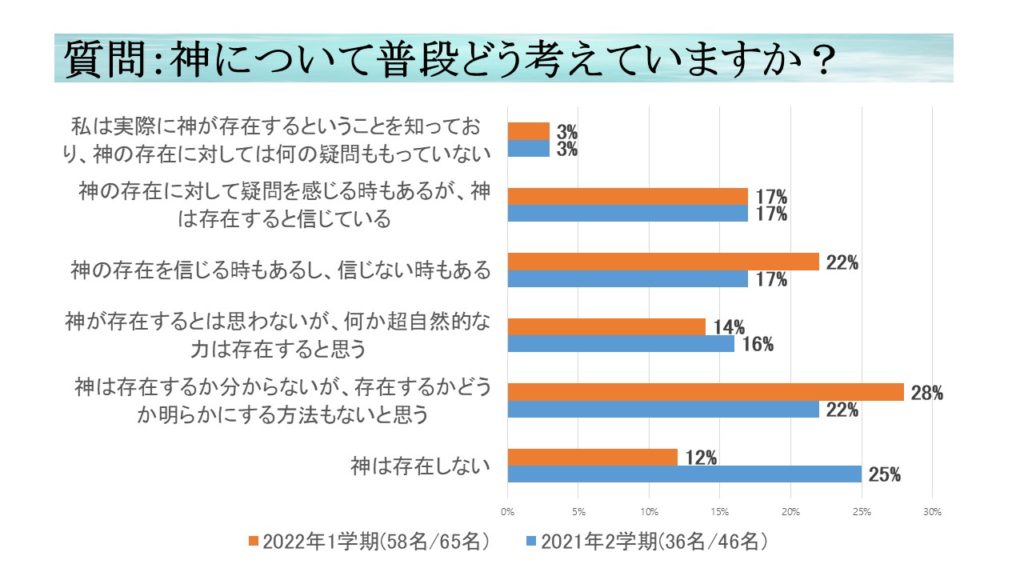
Compiled by the author
Many religions present concepts such as heaven (or the Pure Land) and hell as destinations after death. Yet these ideas were largely developed by later religious leaders who systematized existing beliefs in order to sustain the faith of followers or preserve religious institutions. Jesus and the Buddha themselves focused less on the afterlife than on how to live in this world. They struggled deeply with this question, practiced the answers they discovered with their own lives, and passed those teachings on to their disciples.
Most people imagine heaven as a pleasant and joyful place, while hell is thought of as a terrifying realm of suffering. These images are often equated with the concepts of happiness and unhappiness. In other words, heaven represents a place without hardship, while hell represents a place filled with suffering. This leads to the idea that comfort equals happiness, while hardship equals unhappiness.
But is a life without hardship truly a happy one? If someone eats whatever they want, avoids all unpleasant tasks, ignores others, acts only for their own convenience, and spends their days lying around doing nothing, would that really lead to happiness? Such a lifestyle would quickly harm one’s health, lead to illness, or even push someone toward crime. Alternatively, one might simply lose in competition with others and end up being exploited. For this reason, heaven and hell may not exist as opposite places. Rather, heaven may lie beyond the hardships of hell. This may explain why religions emphasize gratitude, service, and living for others. These are not easy paths. Yet although religions rarely state it explicitly, they seem to suggest that when one practices a life of altruism—serving others and expressing gratitude—one eventually comes to feel happiness within that very way of living.
The Meaning of Being Aware of Death
Many Korean students appeared to be trapped in constant comparisons with others, competing for superiority while losing sight of their own individuality. I therefore wanted them to pursue not only financial success but also their own dreams—to challenge life in their own ways. That was why I established the “Culture of Death” course as part of the university’s liberal arts curriculum.
When the disciple asked about the decisive difference between those who succeed and those who do not, Dōgen replied “Those who strive have aspiration. Those who do not strive lack aspiration. That is the difference.” He continued “Those who have aspiration truly understand that human beings must die. Those who lack aspiration do not truly understand that human beings must die. That is the difference.”
In my classes, I tried various methods to encourage students to become conscious of death. One example was introducing the Seiko Time White Paper, published by the Japanese watch manufacturer Seiko. The Seiko Time White Paper 2019 surveyed 1,200 men and women in Japan aged 10 to 60 via an internet questionnaire conducted on April 24–25, 2019. It calculated how much time people have left to spend with their loved ones. One striking finding was this: A 35-year-old person who lives apart from their mother has only about 26 days left in their lifetime to meet and talk with her in person.
[Table 2] Remaining Time to Meet and Speak with Loved Ones (Days)
」-1024x515.png)
Source: Edited from data in Seiko Time White Paper 2019, Figure 10
https://www.seiko.co.jp/csr/stda/archive/2019/detail.html
Interviewing Parents and Family Members
After presenting this example, I gave my students an unusual homework assignment. They were asked to interview their parents or family members about two questions “What do you think happens after death?” and “How would you like your funeral or the handling of your body to be conducted?” Because I knew students might feel uncomfortable asking such questions, I told them jokingly “Just say it’s homework from a strange Japanese professor.”
Let me share two of the students’ reflections from these interviews.
I had never seriously thought about my family’s death before. But when I interviewed my parents and saw them imagining death and struggling with the question, my heart hurt. The phrase “Show filial piety while your parents are still alive” came to mind. Listening to their thoughts about life and death allowed me to glimpse the paths they had walked in life. It was a valuable experience.When my mother said, “Everyone dies someday. That’s why I want the process to be beautiful,” I realized once again that the day will come when I must part from my mother and family. Tears nearly came to my eyes. I held them back in front of her, but I realized that living wholeheartedly with my family now may be what makes that eventual farewell beautiful. This assignment made me think that I must cherish each moment and live earnestly.
I had been worried about how students might react, but in the end I was glad I assigned the exercise. My main goal was to encourage them to think about death. At the same time, I hoped it would lead to deeper conversations with their families—about their parents’ marriage, about the student’s birth, about what their parents had wanted to do in life or still wished to do. Because no one knows when death will come, it is better to ask while we still can.
A Society Where Death Is Hard to Imagine
One of the interview questions I assigned asked “How would you like your funeral to be conducted?” Traditionally, burial was practiced in Korea, but cremation has rapidly increased in recent years. Funerals often last three days, which is similar to Japan. However, a major difference is that funeral halls are usually located within hospital grounds, and ceremonies take place there. The body is kept in the hospital morgue and placed in the coffin only shortly before the funeral procession on the third day. Therefore, during the wake there is no body in the coffin—only a photograph. Another difference is that fewer people wish to die at home; many pass away in hospitals.
One possible reason may be that people feel less attachment to their homes or hometowns. During my 36 years in Korea, I moved 17 times. While my case may be extreme, frequent relocation is relatively common due to the country’s real estate system. Under such circumstances, it is difficult for people to develop strong attachments to homes or communities. Furthermore, rapid modernization and urbanization have led to a sharp rise in single-person households, which accounted for about 42% of all households in 2024. As a result, many people have fewer opportunities to witness their parents’ final days due to old age.
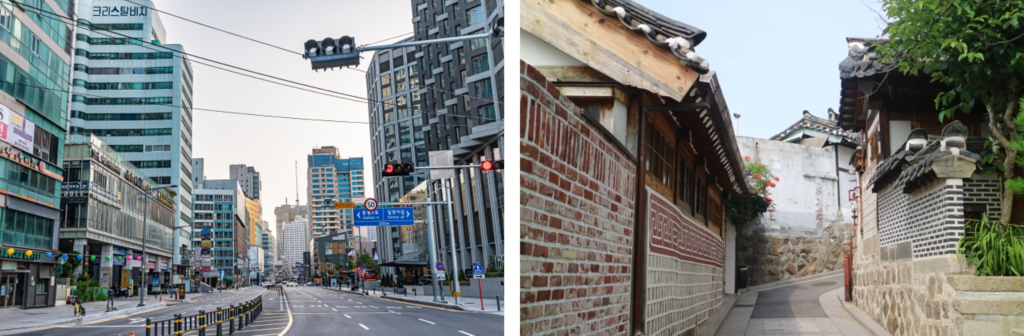
(Left: Modern skyline of Haeundae, Busan / Right: Traditional houses in Bukchon Hanok Village)
Image source: photoAC
Unlike Japan, it is also uncommon in Korea to see temples and cemeteries integrated into everyday townscapes. Because burial was traditionally practiced, graves were typically located on hillsides in rural areas, and urban columbariums are rarely visible. These circumstances may also contribute to the difficulty Korean students have in developing an awareness of death. In short, death has become distant from daily life in Korean society.
About three years ago, I returned to Japan. At Japanese universities, I have continued teaching courses on death, including similar interview assignments. Due in part to the influence of Shinto, Japanese people may have a stronger sense of reverence toward the afterlife and unseen beings than Koreans. Nevertheless, many Japanese students today also tend to avoid organized religion, perhaps out of concern that it may restrict their freedom. As a result, young people sometimes turn instead toward more loosely defined spiritual ideas rooted in Shinto. Organized religion certainly has its share of problems. Yet the core teachings of religion—its reflections on how to live and how to understand death—contain important insights for forming one’s own attitude toward life.
For many people, views on life and death are shaped only when they lose someone close to them. But by that time, it may already be too late. If we wish to pursue our dreams, cherish the present moment, and live with purpose and effort, it is essential to reflect on death beforehand.
In my Japanese classes, I have even organized coffining experiences, where students learn how the deceased are prepared for burial. Nearly half of the students participated voluntarily and later said it had been a meaningful experience. When young people seriously recognize that death inevitably comes to everyone, they may come to see the present moment as precious—and choose to live fully, pursuing their dreams and goals with dedication.
