EN-ICHI Opens Up the Future of Family and Community
The “Will to Live” and Awareness of Death among Young People in Contemporary Korea (Part 1)

South Korea experienced rapid economic growth beginning in the late 1960s, a period often referred to as the “Miracle on the Han River.” In 1988, the country hosted the Seoul Olympic Games, symbolizing its emergence on the global stage. However, only a few years later—around the late 1990s—Korean society seemed to begin changing. Despite its remarkable economic development, various problems began to surface in the realm of mental and spiritual well-being. This was not merely my personal impression; it was also a common perception shared among foreigners who had lived in Korea for many years.
In this two-part article, I would like to argue that a pervasive sense of stagnation has spread throughout contemporary Korean society, and that a cultural shift—specifically, the loss of an awareness of “death,” which is essential for reflecting on the meaning of “life”—lies behind this phenomenon.
A Strong “Will to Live” in Earlier Korea
Allow me to begin with a brief personal introduction while describing how Korea has changed over time. After graduating from a university in Japan, I decided to see more of the world and moved to Korea. I eventually became a university professor there and spent 36 years of my life in the country.
When I first arrived in Korea in 1987, the country’s economic conditions seemed roughly twenty years behind those of Japan. Yet the people were full of energy and determination, striving toward their dreams. Even amid economic hardship, there was a palpable sense of vitality and hope. I felt that Koreans possessed an extraordinary strength in their will to live.
One thing that struck me as unusual when I first came to Korea was the common greeting people used. Instead of saying “Hello” (Annyeonghaseyo), which I had learned in school, people would ask, “Have you eaten?” If you answered, “No,” they would often say, “Then let’s go eat,” and I was frequently treated to meals. Koreans tend to have a culture of generously treating others to food. Looking back now, perhaps the person inviting me was simply hungry themselves and did not want to eat alone. Still, what left a strong impression on me was that after treating me, they would proudly say, “Koreans are warm-hearted, aren’t we?” Even the women at humble neighbourhood restaurants would say, “Please eat a lot,” and bring out extra side dishes.
Photo source: photoAC
A Shift in Mentality
This atmosphere began to change sometime in the late 1990s, after Korea had experienced dramatic economic development. The kind of greetings mentioned earlier seemed to become less common. Restaurant owners also stopped saying, “Eat plenty,” and instead began saying, “Eat well and enjoy it.”
Compared with Japanese people, Koreans often appear to have a stronger sense of subjectivity. They tend to assume that others feel or think the same way they do. By contrast, Japanese people often feel that if their own thoughts or feelings differ from those around them, they should adjust themselves to match the surrounding environment.
Perhaps this shift was simply a result of Korea’s increasing prosperity. People were no longer living in a situation where hunger was common, so they assumed that others were not hungry either and therefore treated others less often. Or perhaps once people became able to eat well, a different kind of anxiety emerged—the fear that someday they might lose what they had gained. In some ways, it seemed that people gradually became less sensitive to the suffering of others. Of course, even today people still say, “Let’s go eat,” especially around mealtimes. But now it often feels more like a matter of routine—simply because it is time to eat.
Around the same time, another change became noticeable: the way people spoke to one another. Informal, non-honorific speech began to be used more frequently. Previously, if one were to express it in Japanese terms, children might say something like, “Father, would you like to have your meal?” But gradually this shifted to something more like, “Dad, want to eat?” In the past, children often spoke to their parents using formal or honorific language. However, for reasons such as fostering a sense of closeness, it became more common to use casual speech within families. At the same time, rapid economic development and urbanization accelerated the shift toward nuclear families. As a result, children had fewer opportunities to witness their parents speaking respectfully to their grandparents. If children rarely see their parents showing filial piety toward grandparents, it becomes difficult to expect that those children will later demonstrate similar respect toward their own parents.
The Growing Problem of Suicide
What is most tragic is that South Korea’s suicide rate rose sharply beginning in 1998, immediately after the Asian financial crisis of 1997. By 2003, the number of suicides per 100,000 people in Korea had surpassed that of Japan. Except for the year 2017—when Lithuania briefly recorded a higher rate—Korea maintained the highest suicide rate among OECD member countries from 2003 onward.
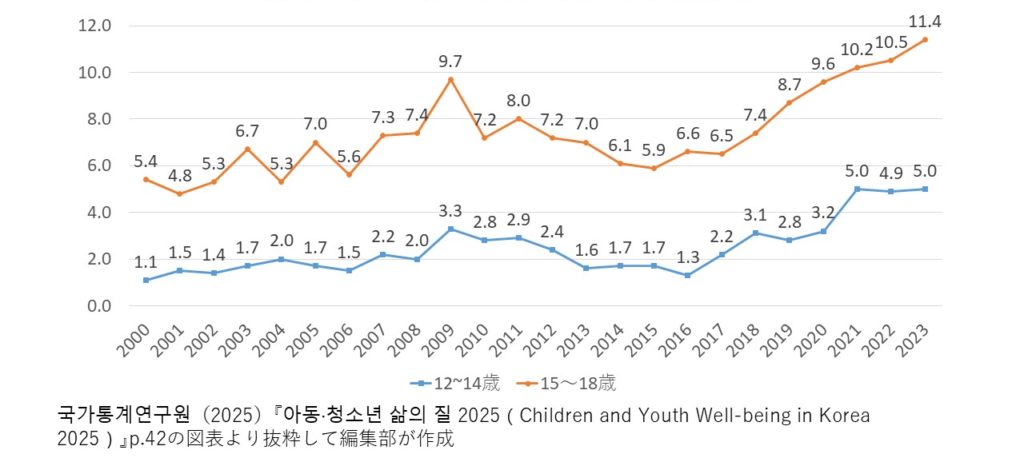
In Korea today, suicide is the leading cause of death among young people. The suicide rate among teenagers—particularly high school students—has been increasing. In 2023, the rate among those aged 15–18 reached 11.4 per 100,000 people. Among emergency patients in their teens and twenties, suicide attempts account for roughly 40 percent of cases, making this a deeply serious social issue. According to Korean media reports from 2011, a police investigation covering the period from 2001 to 2007 found that an average of about 230 university students died by suicide each year, with the number reaching 268 in 2003. Since Korea has roughly 300 universities, this roughly means that, statistically speaking, each university loses one student to suicide every year. Fortunately, at the university where I worked, I never heard of a suicide case during the nearly 30 years I spent there. Nevertheless, I could not help worrying that one day a student in my own classes might take such a tragic path.
[Table] Trends in Suicide Rates among Teenagers in South Korea (per 100,000 population)
A Society Where Stress Is Pushed to the Breaking Point
When discussing the causes of student suicides, several factors are frequently mentioned: intense competition for university entrance, difficulty finding employment, feelings of relative deprivation amplified by social media, mental health issues, stress related to the COVID-19 pandemic, and family circumstances. Korean society is characterized by extremely intense competition, and the stress that arises from it can be overwhelming.
Historically, the recruitment of government officials in Korea was based on the civil service examination system known as gwageo. The influence of this tradition still persists today, contributing to a strong emphasis on academic credentials and entrance examinations. Parents invest large amounts of money in their children’s education in hopes of getting them into prestigious universities. Children, in turn, carry the weight of their parents’ expectations as they face fierce academic competition. Young Koreans often feel immense pressure to succeed. Parents may say, “We have spent so much money on your education—you must live up to our expectations.” When this pressure reaches its limit, some young people conclude that they have failed completely, which can tragically lead to suicide.
In a society that places overwhelming importance on academic achievement, the kind of experience common in Japan—where students devote themselves to club activities and enjoy their youth—is difficult to cultivate. Perfectionism is pursued everywhere. One must be number one. If one cannot achieve that, one is considered a failure. In 2011, a tragic incident occurred at one of Korea’s elite universities: within just three months at the beginning of the year, four students and one professor died by suicide. The cause was reportedly extreme stress resulting from intense academic and research competition.
These were students at a top university. If they had attended another university, they might have been among the best students there. Why were they unable to think that way? In Japan, even if one does not become number one, it is possible to find a field where one can contribute to society and become irreplaceable—someone uniquely valued for what they alone can offer. With this in mind, I proposed to the university where I was teaching that we establish a liberal arts course titled “The Culture of Death.” The course was eventually introduced.
