EN-ICHI Opens Up the Future of Family and Community
Where Is U.S. Family Policy Headed? - The Shifting Landscape of America’s Family Leave System

Family policy in the United States is one of the areas where partisan differences in values are most clearly reflected. For decades, debates over family leave have been shaped by fundamentally different views held by conservatives and liberals regarding the role government should play in supporting families. In recent years, however, signs of change have emerged even among conservatives, who have traditionally been cautious about family support policies. Attitudes toward family policy are beginning to shift.
- Partisan Differences in Approaches to Family Policy
- A Shift in Conservative Attitudes
- Initiatives Under the Second Trump Administration
- Differences in Institutional Design from the Previous Administration
Partisan Differences in Approaches to Family Policy
The United States is a country where policy approaches vary widely along partisan lines. This divide has been especially pronounced in family support policies, including family leave. For many years, conservatives and liberals have held sharply different views on whether—and to what extent—the government should be involved.
Conservatives have generally favored a “small government” approach, emphasizing individual responsibility over reliance on government welfare and prioritizing equality of opportunity. As a result, they have tended to take a cautious stance toward expanding public spending on family support. Liberals, by contrast, have supported a “big government” model in which the state plays an active role in building social welfare systems and emphasizes equality of outcomes. In the area of family leave, the Democratic Party has long advocated the introduction of paid family leave accompanied by income replacement.
A Shift in Conservative Attitudes
The United States has no federal-level paid leave system covering private-sector workers. The primary federal framework related to childbirth and family caregiving is the Family and Medical Leave Act (FMLA), enacted in 1993. However, eligibility under the FMLA is limited: it applies only to employees working for firms with 50 or more employees and requires at least 1,250 hours of work over the previous 12 months, among other conditions.
Moreover, the FMLA guarantees only unpaid leave, allowing up to 12 weeks per year. Because it provides no income replacement, the system differs fundamentally from Japan’s maternity leave and childcare or family caregiving leave programs.
Against this backdrop, the fragility of the U.S. family support system—remarkable even among advanced economies—has prompted growing calls for improvement, including from conservatives who were once reluctant to engage in family policy. One reason is the increasing recognition within the Republican Party that policy should help support family formation as a fundamental unit of society. Concerns about declining birth rates have also added momentum. The total fertility rate in the United States fell to 1.64 in 2020 and further to 1.62 in 2023, well below the population replacement level of 2.1 set by the Centers for Disease Control and Prevention (CDC). As a result, the gap between the United States and other advanced countries in family support policy has increasingly been viewed as a problem even within the Republican Party.
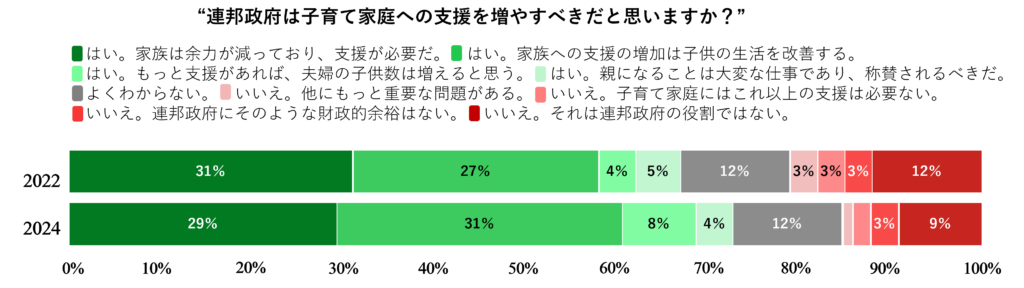
Among younger conservatives, particularly Millennials and Generation Z, there is also a growing openness to family support policies rather than strict adherence to a traditional “small government” stance. According to a survey conducted by the conservative think tank American Compass, 64 percent of self-identified “conservative” or “very conservative” parents responded that “the federal government should do more to support families with children.” This figure represents an increase of 13 percentage points over the past three years.
As part of its policy recommendations, American Compass has proposed more proactive government involvement, including providing monthly benefits per child beginning during pregnancy for working families, and reforming systems so that households can receive sufficient benefits if at least one spouse is employed.
Figure 1. Rising Support for Family Support Policies
Source: Adapted from American Compass (2024a), Figure 1 (translation by the editorial team).
Initiatives Under the Second Trump Administration
Under the second Trump administration, a modified and simplified version of proposals originally put forward by the Biden administration was enacted in July 2025 as the One Big Beautiful Bill Act (OBBBA). Among its provisions related to paid family leave, the law made permanent a tax credit for employers who provide paid leave to their employees.
This change has made it easier for employers to offer paid leave. The eligibility requirement for the tax credit—that employees must have worked for the employer for at least six months—was also relaxed from the previous standard of “one year or more.”
The Biden administration had previously sought to establish a permanent, government-led paid family leave system. However, concerns over the substantial fiscal burden such a program would impose, combined with critical assessments of the administration’s economic management, ultimately prevented the proposal from being realized.

Differences in Institutional Design from the Previous Administration
The Biden administration’s proposal envisioned a nationally guaranteed paid leave system led by the federal government, offering broader coverage and more generous benefits. However, its large fiscal scale posed significant challenges to political feasibility.
By contrast, the Trump administration’s OBBBA approach expands and institutionalizes existing paid leave models through the tax system, relying on a framework that leaves implementation largely to employers. While offering paid leave is not mandatory, employers that choose to do so receive tax incentives. This design reflects the conservative emphasis on individual and private-sector responsibility. Incentive-based systems of this kind tend to be more politically feasible and easier to introduce in a relatively short timeframe.
In this way, although both parties share the goal of supporting families, their policy approaches to family leave have differed markedly. The OBBBA enacted under the Trump administration is notable for pursuing pragmatic expansion while remaining consistent with conservative values. Looking ahead, U.S. family support policy is likely to continue evolving as policymakers navigate the tension between ideological principles and practical feasibility. The growing bipartisan recognition of the need for improvement, however, represents a significant and meaningful shift.
*“EN-ICHI Partners” refers to contributing writers who provide articles to EN-ICHI from their respective areas of expertise.
References
- American Compass (2024a) The Family Policy Renaissance, Explained Republicans, Independents, and the Working and Middle Classes Respond to the Pressures Facing Working Families. https://americancompass.org/wp-content/uploads/2024/02/Family-Survey_Feb-2024_Final.pdf. (Last accessed December 24, 2025).
- American Compass (2024b) The Issues 2024: Family . https://americancompass.org/issues-2024-family/ (last accessed December 24, 2025).
- Hart, Robert. (2024, April 28). "Beikoku no shusseiritsu wa 'kako saitei' ni: Korona-ka iko ni ochikomi tsuzuku" [U.S. birth rate hits a record low and continues to decline since the COVID-19 pandemic]. Forbes Japan. https://forbesjapan.com/articles/detail/70633 (Last accessed December 24, 2025).
