EN-ICHI Opens Up the Future of Family and Community
[Info. File] “Family and Relatives” Are the Most Trusted Support Source In Japan

Based on the Cabinet Office’s “Basic Survey on Social Connections (2024)”
As Japan’s population continues to decline and expectations of shrinking public welfare systems grow, increasing attention is being paid to rebuilding mutual aid within local human networks. This article reports the latest survey findings on people’s awareness and perceptions regarding help and support in times of need.
In April 2025, the Cabinet Office Office for the Advancement of Measures to Address Loneliness and Isolation released the results of the “Basic Survey on Social Connections (2024).” In addition to examining levels of loneliness and social isolation, the survey asked respondents whether they have someone they can rely on when facing difficulties, and whether they have someone to consult about worries and anxieties.
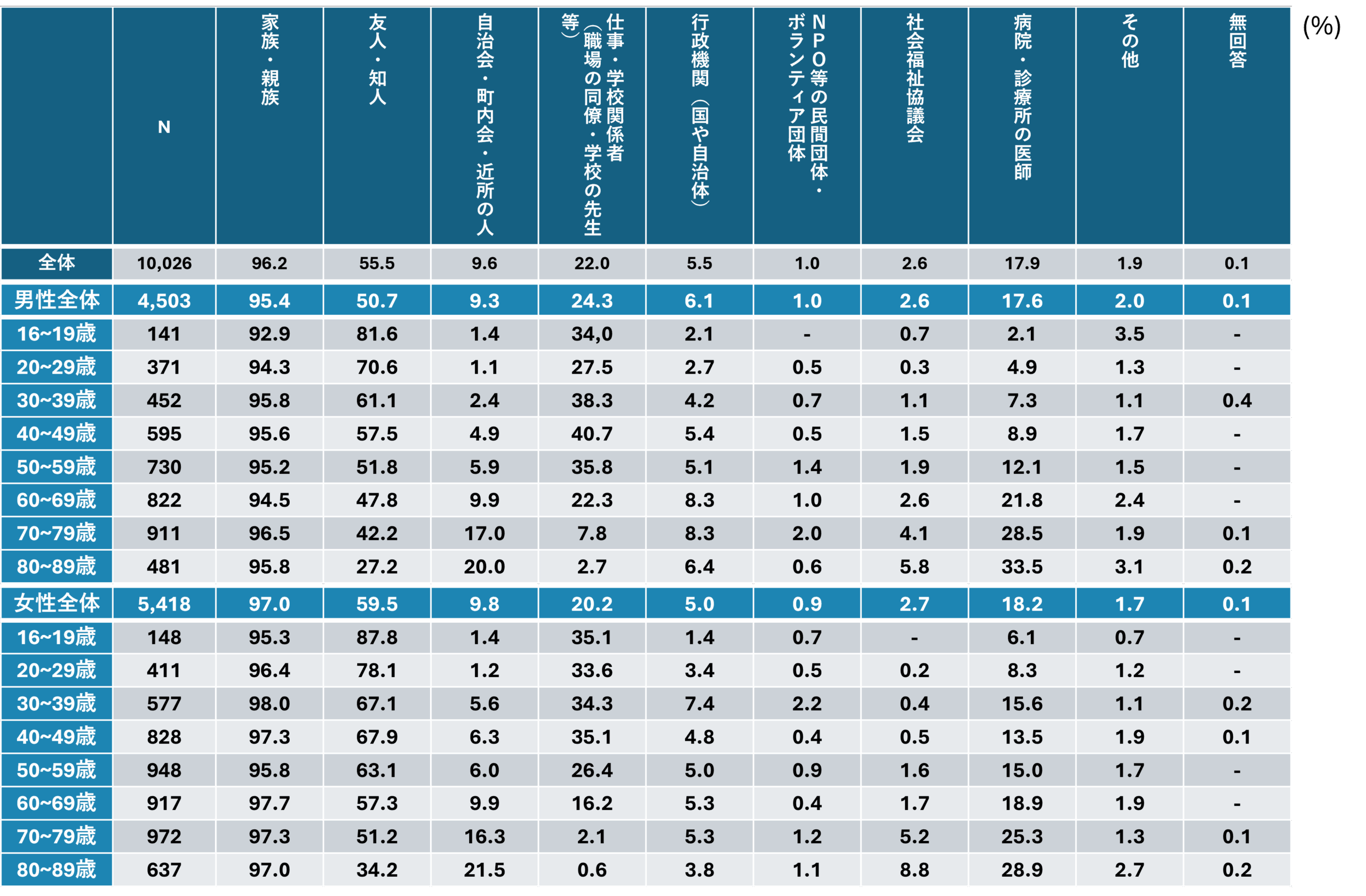
Overall, 92.2% of respondents answered that they “do” have someone they can rely on in times of trouble, while 7.5% said they “do not”. Among those who answered “yes,” 96.2% selected “family and relatives,” followed by “friends and acquaintances” at 55.5% (multiple responses allowed). “Coworkers and school-related people (colleagues, teachers, etc.)” followed at 22.0%, indicating that many people view those they interact with regularly as reliable sources of support.
[Table 1] Types of People One Can Rely on in Times of Trouble, by Gender and Age Group (Multiple Responses)
Source: 内閣府孤独・孤立対策推進室「人々のつながりに関する基礎調査(令和6年)」より【図1-42】を転載(Cabinet Office Office for the Advancement of Measures to Address Loneliness and Isolation, “Basic Survey on Social Connections (2024),” reprinted from Figure 1-42)。
On the other hand, the share of respondents who consider public welfare institutions or formal support providers as “reliable” remains low. Only 5.5% selected “government agencies,” 2.6% chose “social welfare councils,” and just 1.0% selected “NPOs or volunteer organizations.”
Likewise, the percentage for local community groups—expected to play a complementary role—is not high. Only 9.6% named “neighborhood associations or neighbors” as reliable. While slightly higher than administrative agencies or NPOs, even among women in their 50s—the highest rate within ages 10–59—the percentage was only 6.0%, roughly comparable to that of government organizations. The rate increases among those in their 70s and 80s, suggesting generational differences in lifestyle and community engagement.
Responses regarding consultation partners for worries and anxieties also show similar patterns, with close interpersonal relationships—such as family, relatives, and friends—recognized as the main source of support.
Trends Among Those Experiencing High Levels of Loneliness
The survey also asked about emotional attitudes toward seeking advice. Respondents’ levels of loneliness strongly influenced their views on consulting others. Among those reporting "no loneliness" (18.4%) or "almost no loneliness" (40.6%), many believed that “consulting others can solve problems or provide clues” or that “even if problems cannot be solved, talking makes one feel better” (multiple responses allowed). Notably, over 70% of respondents with low loneliness reported feeling emotional relief even without problem-solving.
In contrast, people with high loneliness were more likely to feel that “consulting others would burden them” or “it is pointless to consult others.” Among those who reported feeling lonely “often or always” (4.3%), 25.5% felt it would burden others, while 40.8% believed it was pointless—significantly higher than other groups.
Using detailed tables available on e-Stat (“Table 1-23: Loneliness”), approximately 40.5% of all respondents reported receiving assistance from family or friends. Among those who reported feeling lonely “often or always,” only 27.2% (128/471) said they received assistance from family or friends.
[Table 2] Percentage of People Receiving Help from “Family and Friends,” by Loneliness Level
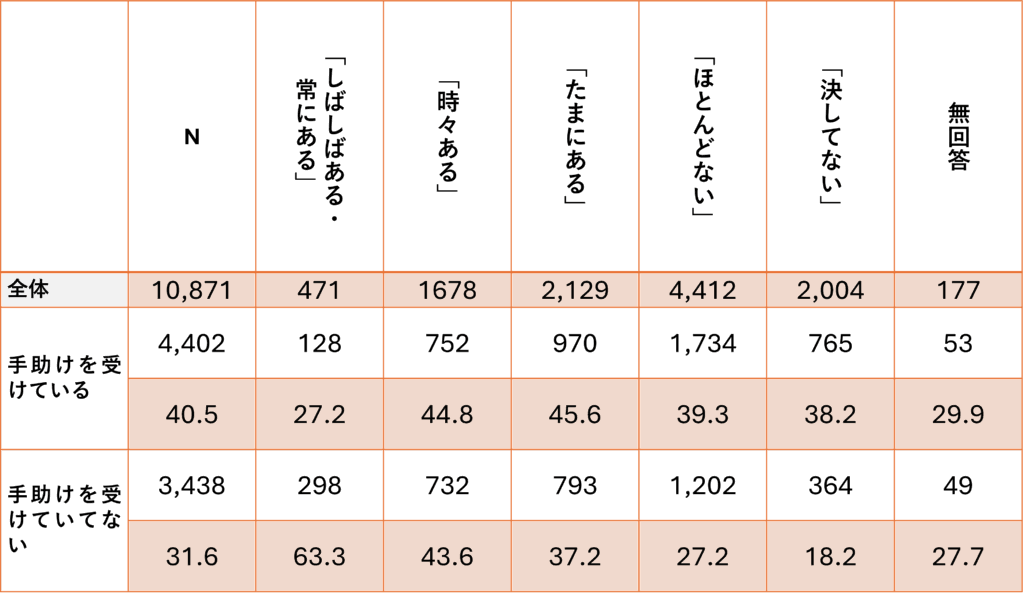
(Top: number / Bottom: %)
Note 1: Percentages rounded to the nearest tenth.
Note 2: Totals do not match the full sample because those who reported having no worries or anxieties were excluded.
Source: 内閣府孤独・孤立対策推進室『人々のつながりに関する基礎調査(令和6年)』「孤独感に関する統計」表1-23より筆者作成(Cabinet Office Office for the Advancement of Measures to Address Loneliness and Isolation, “Basic Survey on Social Connections (2024),” Table 1-23; compiled by the author.)
By degree of loneliness: “Often or always”: 27.2% (128/471), “Sometimes”: 44.8% (752/1,678), “Occasionally”: 45.6% (970/2,129), “Almost never”: 39.3% (1,734/4,412), “Never”: 38.2% (765/2,004). Thus, those experiencing the highest loneliness are least likely to receive help from close personal networks, and also tend not to receive assistance from government agencies or NPOs.
In contemporary Japan, most people identify “family and relatives” and “friends and acquaintances” as those they can rely on in times of difficulty, highlighting the importance of close relationships. In contrast, the presence of neighborhood associations, administrative agencies, and NPOs as trusted support sources remains limited.
Meanwhile, individuals experiencing the highest levels of loneliness are the least likely to receive help from both close personal networks and public support systems. These findings underscore the need to develop strategies to reach and support this vulnerable population.
